Early Signs of Cataracts — When Blurry Vision Needs Attention
Most people don't wake up one morning and suddenly notice they can't see properly. Cataracts don't usually work like that. They creep in slowly and by the time someone finally books an eye check-up, they've often been adjusting to slightly worse vision for months without really registering it. That gradual quality is exactly what makes them easy to ignore.
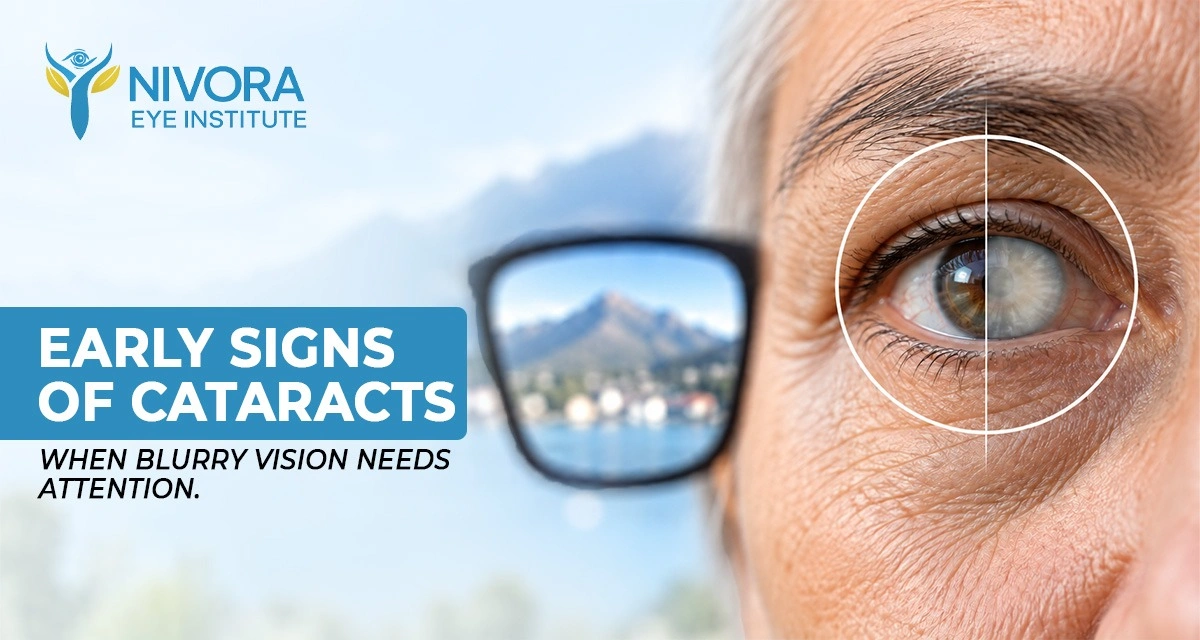
The early signs of cataracts include blurred or clouded vision, difficulty seeing at night, sensitivity to light or glare, halos appearing around lights and frequent changes in your glasses prescription. If any of these are showing up regularly, it's worth getting a comprehensive eye check-up rather than waiting for things to get worse.
Why Blurry Vision Gets Brushed Off
Blurry vision is one of those symptoms people tend to blame on everything except their eyes. Too much screen time, tiredness, an old glasses prescription, poor lighting. Sometimes that's genuinely the cause. But when the blurriness sticks around or keeps coming back even after you've changed your glasses, it's worth taking more seriously.
Cataracts develop when the natural lens inside the eye gradually loses clarity. Because the change happens slowly, your brain quietly adapts to it which is why so many people only realise how much their vision had declined after treatment, not before.
Early Signs of Cataracts Worth Paying Attention To
Here's what usually shows up first. None of these confirms a cataract on their own but if a few of them sound familiar and an eye examination later on makes sense.
• Blurred or clouded vision — the most common complaint and often described as looking through something slightly foggy rather than sharp.
• Difficulty seeing at night — night driving in particular tends to become uncomfortable earlier than other activities.
• Sensitivity to light or glare — bright sunlight or oncoming headlights start to feel harsher than they used to.
• Halos around lights — rings or a glow appearing around streetlights and headlights, especially after dark.
• Halos around lights — if your power keeps shifting and new glasses stop helping for long, that's a signal worth investigating.
These early signs of cataracts often overlap with other less serious eye issues which is exactly why a proper evaluation matters more than self-diagnosing based on symptoms alone.
When to See a Doctor for Cataracts
The honest answer to when to see a doctor for cataracts is — earlier than most people do. You don't need to wait until reading or driving becomes genuinely difficult. If any of the symptoms above are showing up consistently, a comprehensive eye check-up gives you clarity on what's actually happening.
The general process goes something like this:
Getting checked early doesn't automatically mean surgery is next. It means you and your doctor understand what stage things are at and can plan accordingly rather than reacting once daily life is already affected.
What Happens During a Cataract Evaluation
Knowing what an assessment actually involves takes some of the anxiety out of booking one. At Nivora, the process is fairly straightforward:
• Consultation — a conversation about your symptoms, vision concerns and overall eye health.
• Eye evaluation —detailed tests to assess how far the cataract has developed and the general condition of your eyes.
• Lens planning — if surgery is recommended, this is where the team helps you choose the right intraocular lens (IOL) for your lifestyle, whether that's Monofocal, Multifocal, Toric or EDOF.
• Surgery — a quick, minimally invasive procedure using advanced phaco technology, usually completed within 15 to 30 minutes per eye as a day-care procedure
• Follow-up —regular check-ins afterward to track healing and confirm your vision is stabilising with free consultations available for six months
Signs You Need Cataract Treatment Rather Than Just Monitoring
Not every cataract needs immediate surgery. But there's a point where the practical signs you need cataract treatment become clear — usually when the symptoms stop being an occasional annoyance and start interfering with everyday things like reading, driving at night or recognising faces comfortably. Frequent prescription changes that no longer fix the problem are another strong indicator, since glasses can't correct a clouded lens.
At that stage, cataract surgery is worth discussing properly. It's considered one of the safest and most successful surgical procedures performed worldwide when carried out by an experienced team with proper diagnostics and post-operative care. The procedure itself is done under local anaesthesia using topical eye drops so there's no pain during surgery with mild discomfort for a day or two afterwards that's easily managed with prescribed drops.
Related Reading That Might Help
If you're trying to figure out whether now is the right moment to act, our post on when is the right time for cataract surgery covers that decision in more detail.
For anyone supporting an older family member through this, cataract surgery for senior citizens walks through the safety and benefit side specifically. And if you'd like to understand the different surgical approaches available, the different types of cataract surgery is a useful starting point.
How Nivora Eye Hospital Fits into This
Nivora Eye Hospital has been providing advanced vision care in Dehradun for over 37 years under the leadership of Dr. Vinod Arora (M.B.B.S, M.S. Ophth, F.C.L.I.), who was among the first to bring AI-enabled cataract surgery to the region. The hospital has treated more than 1,00,000 patients and performed over 30,000 cataract surgeries with 98% of patients recommending Nivora.
On the technology side, cataract procedures here use modern phacoemulsification systems, including the CENTURION® Active Fluidics™ System with real-time IOP stabilisation and AI surgical precision, along with Zepto-assisted and micro-incision cataract surgery (MICS) options. Smaller incisions mean less trauma to the eye and no stitches required. Patients also get personalised lens guidance across Monofocal, Multifocal, Toric and EDOF options based on their actual lifestyle needs rather than a default recommendation.
Practically speaking, cataract surgery at Nivora typically falls within an affordable range depending on the lens type and technology chosen. The hospital is NABH accredited, accepts mediclaim and insurance with cashless tie-ups across leading health insurance partners and TPAs and holds empanelments with organisations including CGHS, ECHS, BSNL, CAPF and the Survey of India.
Conclusion
Cataracts rarely announce themselves loudly — it's usually the small things first — blurred vision that doesn't quite clear up, harsher glare, halos at night or a prescription that keeps changing without much benefit. Catching those cataract symptoms early simply means you're making decisions with proper information instead of waiting until daily life is already affected.
This is where Nivora Eye Hospital genuinely fits in. With 37+ years of experience under Dr. Vinod Arora, over 30,000 cataract surgeries performed, advanced CENTURION® AI-enabled phaco technology, personalised lens planning, NABH accreditation and free consultations for six months after your procedure, Nivora offers the kind of thorough evaluation and aftercare that makes this whole process far less daunting. Whether you end up needing treatment now or simply want clarity on where your eyes stand, starting with a proper check-up is always the right first move.
So what’s got you waiting? Book your cataract consultation with Nivora Eye Hospital today — call 844-844-8860 or request a call back to take the first step toward clearer vision.