ICL Surgery vs LASIK: Which Is Better for High Minus Power?
If you've worn glasses with a power of -8, -10 or higher for most of your life, you've probably had this conversation with yourself many times: is LASIK even an option for me? Or is my number too high?
It's a fair question and an important one. Not every vision correction procedure is suited for every prescription. For people with very high myopia — what's commonly referred to as high minus power — the choice between LASIK and ICL surgery becomes genuinely significant because one of them may not even be medically advisable depending on your corneal measurements.
Hence, this blog breaks down ICL surgery vs LASIK specifically for high power prescriptions so you understand not just what each procedure does but which one is actually likely to be right for your eyes.
Understanding High Minus Power
In simple terms, minus power refers to myopia or nearsightedness. The higher the number -6, -8, -10, -12 and beyond, the more nearsighted you are and the thicker your glasses lenses tend to be.
High minus power isn't just a bigger version of the same problem. At higher prescriptions, the amount of corneal tissue that would need to be reshaped to correct vision through laser surgery increases significantly. And here's the key issue: the cornea has a limited amount of tissue that can be safely removed. Beyond a certain point, removing more tissue isn't safe — it can compromise the structural integrity of the cornea and lead to complications.
This is exactly where the conversation around high minus power treatment becomes more complex and where ICL often enters the picture as a genuinely better option for many patients.
How LASIK Works (and Where It Has Limits)
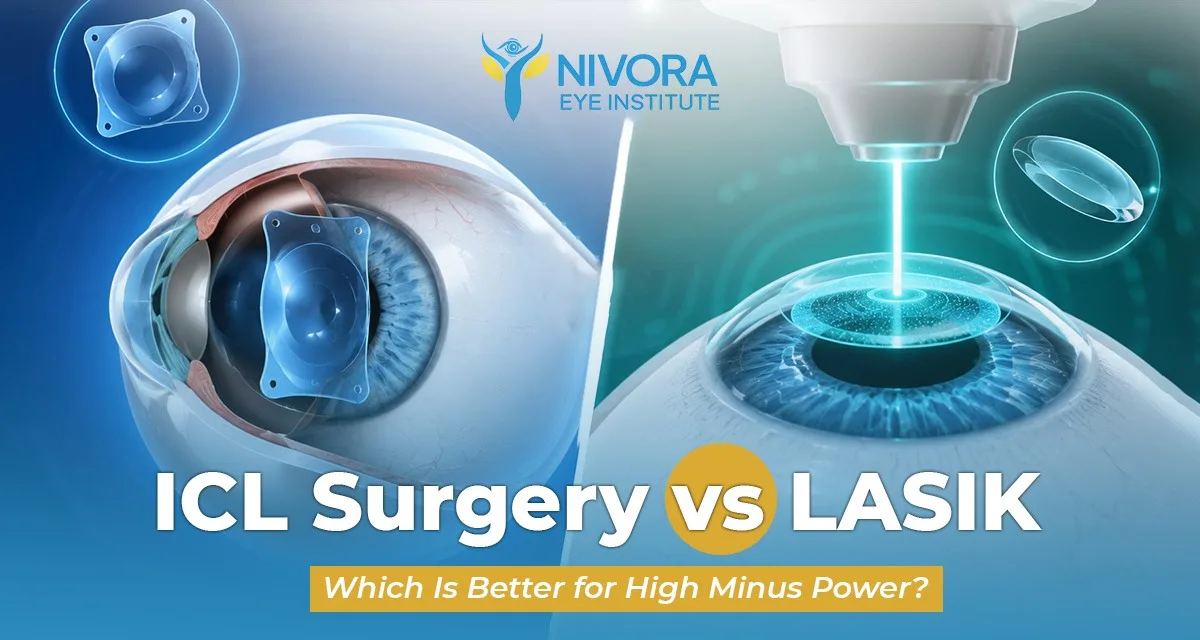
LASIK works by using a laser to reshape the cornea — removing a thin layer of corneal tissue to correct how light focuses on the retina. For low to moderate prescriptions, this works beautifully and has an excellent track record spanning decades.
But LASIK requires a minimum corneal thickness to be performed safely and the amount of tissue removed increases with the power being corrected. For someone with a prescription of -8 or higher, the required tissue removal may exceed what their cornea can safely accommodate especially if their cornea is on the thinner side to begin with which is fairly common.
In these cases, even the best LASIK eye surgery performed by the most skilled surgeon using the most advanced technology may not be a safe option — not because of the surgeon's skill but because of the physical limitations of the cornea itself.
What Is ICL Surgery?
ICL stands for Implantable Collamer Lens. Unlike LASIK, ICL eye surgery doesn't involve reshaping the cornea at all. Instead, a small, biocompatible lens is placed inside the eye — between the iris and the natural lens — to correct the refractive error.
Think of it as similar to a contact lens, except it's placed permanently inside the eye through a small incision, rather than sitting on the surface of the eye. The procedure is minimally invasive and because it doesn't involve removing any corneal tissue, it's not limited by corneal thickness in the same way LASIK is.
This makes ICL particularly well-suited for patients with high minus power including prescriptions as high as -18 or more in some cases and for patients whose corneas are too thin for LASIK regardless of their prescription level.
ICL Surgery vs LASIK — Key Differences for High Power Prescriptions
When comparing ICL surgery vs LASIK specifically for high minus power, a few factors consistently come up in consultations:
Corneal tissue requirement. LASIK reshapes the cornea by removing tissue. ICL does not remove corneal tissue; instead, the lens is implanted inside the eye through a small incision. For high prescriptions, this is often the deciding factor.
Range of correction. LASIK is generally most effective and safest for low to moderate myopia. ICL can address a much wider range including very high prescriptions that LASIK simply cannot treat safely.
Reversibility. ICL is technically reversible — the lens can be removed or exchanged if needed. LASIK, since it involves permanent reshaping of the cornea, is not reversible in the same way.
Dry eye considerations. Some patients with high myopia who are also prone to dry eyes may find ICL a more comfortable option, since it doesn't affect the corneal nerves in the same way LASIK does.
Procedure time and recovery. Both procedures are outpatient and relatively quick, though ICL involves a small incision and may have a slightly different recovery pattern compared to LASIK's surface reshaping.
| Factor |
LASIK |
ICL Surgery |
| How it works |
Reshapes the cornea using a laser |
Places a biocompatible lens inside the eye |
| Suitable for high minus power |
Limited by corneal thickness and prescription range |
Highly suitable, including very high prescriptions |
| Corneal tissue removal |
Yes |
No |
| Corneal thickness requirement |
Adequate thickness required |
Less dependent on corneal thickness |
| Typical correction range |
Best for low to moderate myopia |
Can correct very high myopia (often up to -18D or more) |
| Reversibility |
Permanent corneal reshaping |
Lens can be removed or exchanged if required |
| Dry eye risk |
May worsen existing dry eye symptoms |
Generally lower impact on dry eyes |
| Procedure duration |
Usually 10–15 minutes for both eyes |
Usually 20–30 minutes for both eyes |
| Recovery |
Rapid visual recovery, often within a day or two |
Quick recovery, though vision may stabilize over several days |
| Best suited for |
Patients with moderate prescriptions and healthy corneas |
Patients with high minus power or thin corneas |
So Which One Is Actually Better?
Here's the honest answer: it depends entirely on your eyes and specifically on your corneal thickness, corneal shape and the exact power that needs correcting.
For patients with low to moderate myopia and corneas of adequate thickness, LASIK remains an excellent, safe and well-established choice — and continues to be the right option for the majority of people seeking vision correction.
For patients with high minus power — particularly anything above -8 or -10 — or for patients whose corneal thickness doesn't meet LASIK's safety requirements regardless of their prescription, ICL is often the more suitable and safer option. In many such cases, ICL isn't just an alternative — it may be the only viable surgical option for achieving glasses-free vision.
The determination is made through a comprehensive eye evaluation — corneal topography, pachymetry (corneal thickness measurement), pupil size assessment and anterior chamber depth measurement for ICL candidacy. This is not something that can be assessed from a glasses prescription alone which is why an in-person consultation with detailed diagnostics is essential.
What to Expect During the Evaluation
If you have high minus power and are exploring your options, expect a thorough diagnostic process. Your surgeon will measure your corneal thickness and shape, check the health of your retina (which is particularly important for high myopes as the risk of certain retinal conditions increases with higher prescriptions), measure the internal dimensions of your eye for ICL sizing if relevant and discuss your lifestyle and visual goals.
This evaluation is what determines the right path — not a general rule of thumb and not what worked for a friend or family member with a different prescription.
Conclusion
For people with high minus power, the choice between LASIK and ICL isn't a matter of preference as much as it is a matter of what your eyes can safely support. LASIK remains a fantastic option for moderate prescriptions with adequate corneal thickness, while ICL has opened the door to safe, effective, glasses-free vision for people with very high prescriptions who previously had limited surgical options.
Nivora Eye Hospital in Dehradun offers both LASIK and ICL surgery, along with the full range of advanced vision correction options including Femto LASIK and Contoura Vision. With over 36 years of experience and more than 35,000 LASIK and refractive procedures performed under the guidance of Dr. Vinod Arora, Nivora has the latest technologies, diagnostic capability and surgical expertise to determine which procedure is genuinely right for your eyes particularly for patients with high minus power who need that decision made carefully and correctly.
Using US-FDA approved technology and a thorough pre-surgical evaluation process, Nivora ensures that every patient — whether a candidate for LASIK or ICL — receives a recommendation based on their individual eye measurements, not assumptions. With free post-operative consultations for six months after surgery, the care continues well beyond the procedure itself.
If you've been told your power is "too high" for LASIK, that doesn't mean glasses-free vision is out of reach. A proper consultation at Nivora Eye Hospital is the right next step to find out what's actually possible for your eyes.
Ready to explore a safe and effective solution for your high minus power treatment? Schedule your consultation with Nivora Eye Hospital or call us at 844-844-8860 today and take the first step toward clear, glasses-free vision.
Also read: How LASIK Treatment Can Improve Your Vision Permanently